Have You Ever Seen a Tree?
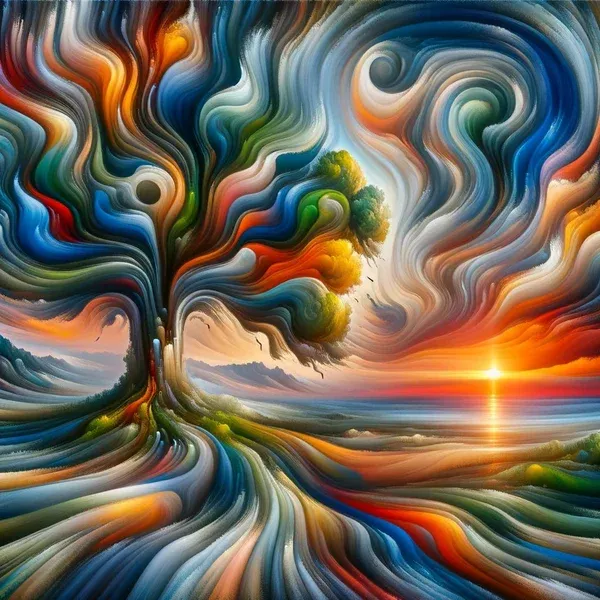
If you are reading this, you are probably thinking: “of course I have seen a tree, I have seen entire forests, what a silly question!” And granted, I would have thought the same not that long ago. I would have gladly accepted it as a truth and marked the question as absurd. So let’s do a little thought experiment to see if what we are claiming here holds true. After all, if it is obvious, we should be able to justify it.
The initial claim is that I have seen a tree. Let’s dive into this together.
Q: “Where did you see the tree?”
A: “There’s one just outside my window”
Q: “Ah, I see, that over there? How do you know that it is a tree?”
A: “Well, it is obvious… You keep being silly, it is a tree because it has a trunk, branches, leaves, roots…”
Q: “So, this tree, it is made up of multiple parts it seems. If that is the case, where is it then?”
A: “It is there, I am pointing at it!”
Q: “Yes, but is the tree in the bark, is it in the leaves, in the branches, in the roots, in the fruit or flowers it may bear?”
A: “Well, it is all of those things combined.”
Q: “I must ask, when these characteristics combine, at which point do they become a tree?”
A: “It’s tricky, I suppose the tree is a result of all of that?”
Q: “Can we agree that the tree is dependent on all of its parts to be labelled as such? In other words, for it to exist as a “tree” it depends on all of its subparts?”
I’ll pause and let you answer this hypothetical dialog as you wish. For me, it seems hard for to deny the following fact: if the tree is the sum of its component parts then it must be dependent on them.
Words can be deceiving. We have this idea of a “tree”, this amalgamation of features that results in an identity we assign to something that we see. We are claiming that the thing we see has an identity, it is a “tree”. We must then dig deeper into this idea of identity. Do things that change have identity? Surely, change and identity are juxtaposed. If there is change, there is impermanence. Identity cannot be established in a state of impermanence. As time unfolds our so-called “tree” is changing continuously, just like everything else. Can we agree that calling it “a tree” is imprecise at the very least?
Can you spot the gap? Here is this thing that we confidently label as a tree but that upon closer inspection we find that not only does it depend on all of its parts but it also cannot assume a permanent identity. So can it be said to be a tree? Aren’t we making a mistake in ascribing identity to it when we agree on the above?
Language and words are a wonderful tool, one that sets us apart from the rest of creatures. Yet words are metaphors, they are approximations. All words are metaphors that we take for granted; they are attempts at describing the experience of reality. So can this “tree” that we see, be said to be a “tree” from this logical standpoint? It seems that this thing I observe and experience can never be fully captured with any word. The experience is beyond the mind, in the sense that it is beyond what language can describe.
“Do you know that even when you look at a tree and say, ‘That is an oak tree’, or that is a banyan tree’, the naming of the tree, which is botanical knowledge, has so conditioned your mind that the word comes between you and actually seeing the tree? To come in contact with the tree you have to put your hand on it and the word will not help you to touch it.” ― Jiddu Krishnamurti, Freedom from the Known
Let’s break this down a little. It is by labelling, by finding the specific taxonomy, classifying, and intellectualising that we make an attempt to capture our understanding of what we observe; and this is important. It enables science to move forward, it enables us to navigate nature. This is conditioning and one must remember that the word is merely an approximation of the thing. When you label a tree as a tree, you cease to look at it. The word gets in the way of the experience. Can you see this happening? Can you see yourself labelling the world? What if we were to let go of all that?
It may seem extreme to question language itself and all that we have known. Yet, there is something special to be found when we let go of the word, even if briefly. When we are really paying attention, that is, experiencing the thing without labelling it (i.e. seeing the tree as raw reality), the mind becomes still. Mental energy is no longer dissipated by thought / the mental process of intellectualisation and instead is fully devoted to the experience of the thing (what is).
This is not a denial of concepts, that would be something more similar to nihilism and outright insanity. Words may be imprecise but they are the tools we have got to communicate with one another. But when we are looking inside, within the confines of our own mind, when we are occupied with thought… Are concepts necessary there? What if you were to let go of them? Could we accept that there is an element of philosophical fallacy in concepts and ideas? And if we look at the tree again, can we find something new in that “tree” we claim to always have seen? And if this “tree” is unlike any other we have encountered: its unique configuration, location, position, how can we possibly describe this tree and the one next to it with the same word? Ultimately, the identity we ascribe to them is merely a convention.
I like the distinction in Mādhyamaka Buddhism between the conventional/everyday truth and the ultimate truth. From the ultimate standpoint, we have to be ruthless with the way we analyse everything. No concept escapes this analysis. In fact, the whole body of knowledge ever created by humans will always remain a man-made creation. From the ultimate standpoint, one must accept things as empty, i.e. not having an inherent existence, always changing from moment to moment, unable to assume an identity that is constant over time. And in this space, true freedom from the mind can be found.
From this standpoint, I have never seen a “tree” because there is no such thing as a “tree”. There is only direct experience of the thing itself…
So here are a bunch of questions that are to be experienced for oneself. What you will find is ultimately up to you. All I have to say, is that I wish someone had made me question this sooner.
References: