Lessons from the mountains
The Dewa Sanzan are one of the lesser-known spiritual centres of the world. These three sacred mountains are located in the Yamagata Prefecture, in northeast Japan (Tōhoku region). Each of them is linked to a dimension of time:
Haguro-san(羽黒山) represents the world of the present and the salvation of current hardships. Gassan(月山)represents the past or the afterlife, where we atone for our wrongdoings. Yudono-san(湯殿山)embodies the world of the future and marks the location where we are reborn.
This is a place where people go on pilgrimages, some of them travelling hundreds of kilometres to go pray in its shrines and temples. Due to its extensive spiritual tradition, this region of Japan is special and is best understood by joining its spiritual teachers in prayer and staying at the pilgrims’ lodges.
During my recent travels in Japan, I had the privilege of visiting this wonderful place. I will be forever grateful to my wife for pushing me to solo travel and train with the Yamabushi there.
The Yamabushi and shugyō
The Yamabushi are Japanese mountain ascetics who practise Shugendō, a mountain-based spiritual tradition blending Buddhist, Shintō, and folk practices. Access to this training is made possible by the great team at Yamabushido, which is working hard to preserve this area and its unique and amazing traditions. The training is known as shugyō. This roughly means “cultivating conduct” and is a form of physical and spiritual training. The idea of cultivation serves as a reminder that awakening and personal breakthroughs are something that one needs to cultivate. It is something that needs to be both understood and done. During the training, we lived in Tōge village, at the base of Haguro-san and stayed at Daishōbo, the pilgrim’s lodge run by Master Hoshino (a Master Yamabushi) and his family. It was from there that we started all our hikes, and that was also where the training ended.
I have been exploring (and writing about) this idea of awakening for a few years now, and I was interested in understanding the experiences people have with shugyō and how it can transform their path to liberation. I was also looking to disconnect from the world and wanted a way to “escape” turning 30 by doing something different. I also wanted to assess what my experience of dwelling in my mind for extended periods would be. Throughout the training, you are silent, completely disconnected from any form of technology, and with the caveat that personal hygiene is not permitted during the training days.
With this backdrop in mind, I will recount the 3-day training and subsequent reintegration into the world in a diary form and summarize my lessons from this experience and the learnings that came with it.
A hiking diary
Day 1: Mt. Haguro - overcoming early struggles
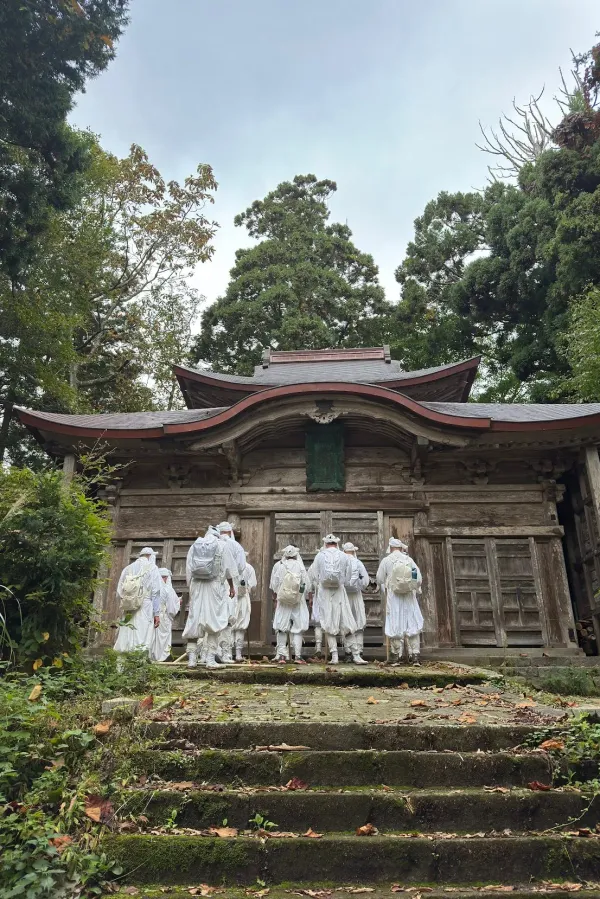
After changing into our Yamabushi garments (shiroshozoku), we set off on the first hike. I found myself oscillating between being present and cursing both the difficulty of the training and my sendatsu (master) for walking too fast and not giving me time to soak in what I was seeing around me. Some other dark thoughts would creep in as they always do… I wondered whether I had made the good choice joining this training? I wondered whether I would even learn anything? There was a mix of arrogance and dissatisfaction. Those were the moments of “monkey brain” where the mind kept chattering (though nowhere near as much as it used to do). I found solace in happy thoughts about my marriage, the bark of the trees, the sound of the forest, the singing of the birds. As we walked from shrine to shrine, repeating the same prayers, I struggled to find my rhythm and, in a sense, could not wait for it to be over…
As the afternoon progressed, I slowed down my pace and stayed towards the back of the group to immerse myself a bit further in the forest. I was starting to feel more connected to things around me and warming up to the experience. Except for the praying, the hikes were all silent, and I found myself enjoying my own company. I went from struggling to find the centre of gravity while wearing the Jitakabi (split-toed shoes) to being a lot more intentional about my steps and feeling them as much as I could. I could feel the rugged steps under my feet, the wet patches of leaves and grass, my foot bending at awkward angles. Every time I slipped or lost my footing, I would find my mind had drifted away into some random thought, and this became more obvious the more we ventured into the mountain.
As we returned to the lodge, we had some time to rest, a little bit of food and did some Yamabushi-style meditation or “tokogatame”, which literally translates to “to harden the floor” or to “solidify your spot on the earth”. In other words, to enhance your level of presence. It’s a form of Za-zen meditation in which you stare at a spot with your eyes open and simply watch your mind do what it does. Part of me seemed intent on “doing it right”, but the futility of the endeavour became obvious, and the mind was quiet when I shifted my attention to the details around me rather than to the constantly passing thoughts. Paying attention to the slow rhythm of my breath was also helpful. The feeling of cold air when breathing in followed by the feeling of warm air when breathing out felt soothing. And while the pain in my hopelessly inflexible hips was intensifying as time went on, it served as a reminder that I was indeed alive…
That night, we were surprised by an impromptu walk in the dark. Seeing the clear sky full of stars felt like a reward after a day of getting used to the unknown.
Day 2 - Mt. Kinbo - the turning point
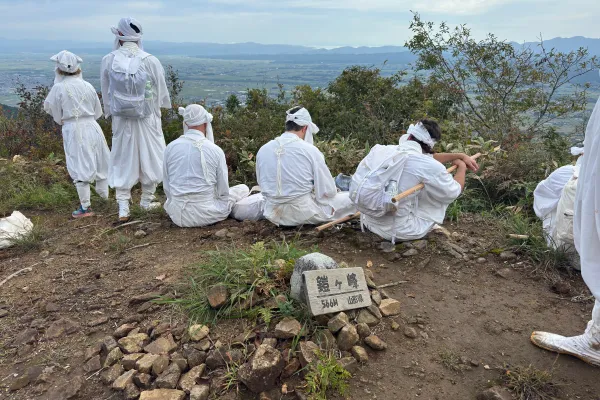
The second day, we set off early in the morning and climbed Mt. Kinbo. While not officially part of the Dewa Sanzan, there is some history connecting it to Haguro-san. This hike was tougher, and we meditated under a waterfall halfway through. As the cold water hit my head, I tried to recite the Heart Sutra but realised that I was not only too slow but still did not know all the words… As I stepped away from the waterfall with a slight headache, I was grateful that it wasn’t a rainy or cold day and felt more connected to the forest and the mountain. Cold water never fails to wake you up.
After that point, I began finding genuine excitement in the training. Every step was more intentional, the little details of nature more vivid. I spotted hidden mushrooms, static spiders in awesome webs and even a minuscule frog, and I am sure I missed a whole lot more. We eventually made it to the summit and soaked in a wonderful view of the area. The silence could be heard then, and my mind was calm, matching the scenery. We sat silently for a few minutes, where nothing else seemed to matter except for that moment.
Day 3 - Mt. Haguro - reaching the summit
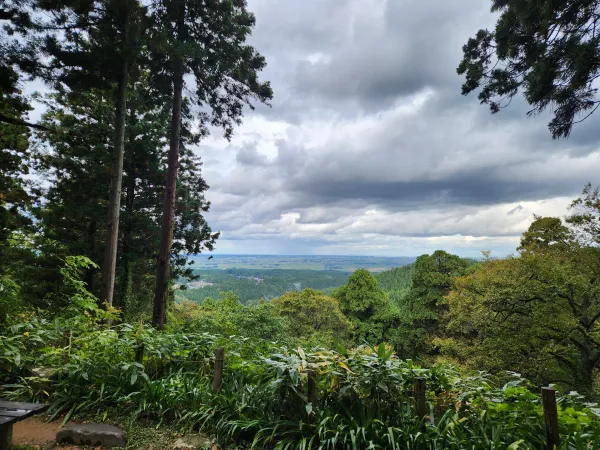
The next day, we went back to Haguro-san and set off to reach the summit and to join in the official morning prayers. Haguro-san is the lowest peak of the Dewa Sanzan at 414m. The peak is reached by climbing a staircase of 2446 steps surrounded by a cedar forest. We walked at a slow pace and took a break halfway, where we all sat together, enjoying a wonderful morning view of the forest and the Sea of Japan in the distance. After all the walking, that moment felt incredibly valuable. We had stopped here before, but we had not really “stopped here before”… Everything felt different, the light, the sounds, the tallness of the cedar trees, the color of the leaves… And I was different, and no longer the same man who started the training.
The summit was a sight to behold. The temples, the pond, the thatched roofs, the decorations inside the temple were overwhelmingly beautiful. Watching the prayers was yet another mesmerizing sight as the voices of the priests and priestess were in perfect unison. The goosebumps were inevitable at this point and I felt my spine tingle multiple times. It was a real privilege to be part of it.
Reintegrating with the world
As the program came to an end, we jumped over fire to symbolize rebirth and mark the end of shugyō. This was followed by a trip to the Onsen, a bath that I sincerely appreciated after the lack of washing. It was good to be reminded to be grateful for the basic things in life. This was followed by a traditional Shinto celebratory ceremony called Naorai. As we ate together, no longer in silence, I had the chance to connect with the other training participants, people from all walks of life. Hearing their impressions and the breakthroughs during the training was more wholesome than I can describe. It is surprising the connections you can build while being in silence, and I am glad we were given the space to share these. The analogy of letting your thoughts go like the Shinkansen (in a flash) resonated and that I will carry with me (merci, Nicolas).
And while their breakthroughs were different from mine, they are a reminder that the journey of liberation is different for all of us and a confirmation that it can certainly not be taught. You must arrive at the conclusions yourself, and you will feel it when you do. It is an experiential understanding. That evening, we moved to Daishinbō, Master Hayasaka’s pilgrims’ lodge, a bit closer to Haguro-san. The last day of reintegration would take place there.
Day 4 - Mt. Haguro - Putting the pieces together
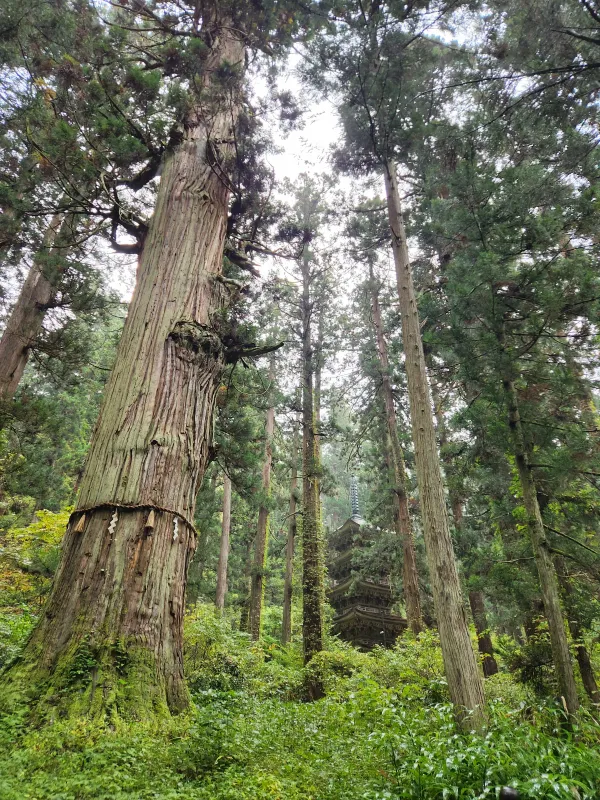
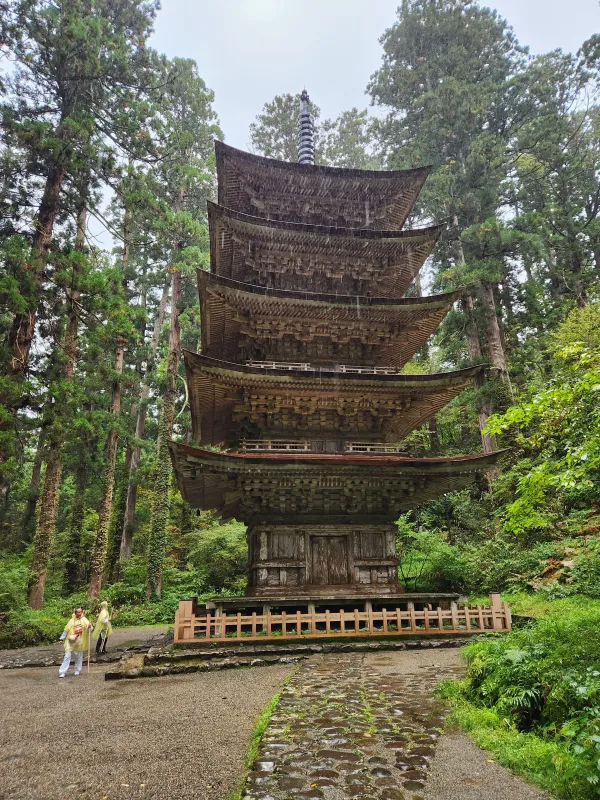
The next morning, we attended the prayers at the lodge with other pilgrims and set off on a guided tour of Tōge and our last climb up Haguro-san. While walking, it felt easy to ease back into silence, and of course, it all felt different once again. Master Harasaka made a point of going up every single step to the shrine at the summit. Along the way, he explained the meaning behind the shrines we prayed at and highlighted key spots, like for example the intricate Dewa Sanzan pagoda and Jiji-sugi, a 1000-year-old tree. I had walked this path before, and yet, I was still oblivious to so much. That day, I felt the prayers completely differently once I stopped paying attention to the words and reading from the prayer sheet. I felt a deeper understanding of these traditions, one that was actually felt rather than learnt.
At the end of shugyō, the Yamabushi say you experience rebirth. Everyone involved had made progress with their own minds. Yet, while it is undeniable that the mountains push you closer to this awakened state, I have found that true freedom lies in experiencing this rebirth at every moment. As we meet the world anew, “without the conditioning reaction of the past,” we are no longer carrying the baggage of the past or the future. In this experience, there is great energy and vitality, and thought no longer dissipates through thinking that is not of the present.
Day 5 - Mt. Haguro - seeing the new
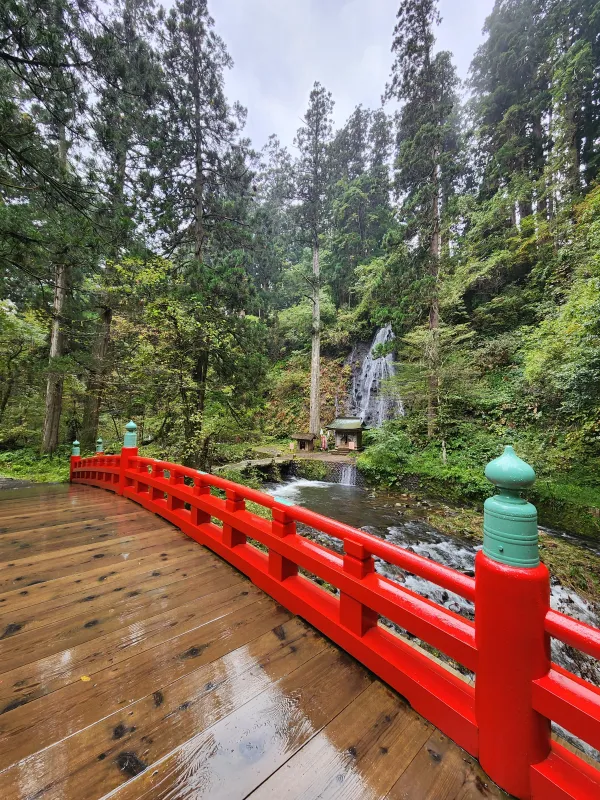
As if three hikes on the “same” mountain had not been enough, I stayed an additional day to go up one last time and take a few pictures for my journal. Ron, a 75-year-old man from Colorado, who had done the program with me, decided to join me that day. His resilience and vitality were impressive to the point that I forgot our age gap completely. This time, we talked while walking as we got to know each other on a deeper level.
Lesson 1 - No hike is ever the same; nothing is
You never walk the same path twice. We’re all a work in progress.
None of these hikes was the same. Each of them had been an opportunity to discover something new about the mountain and about myself. They were a reminder that there is always something new to learn, something to discover in familiar places. Nothing is permanent, and we are a work in progress. And even if you feel like progress is being made, can you still say things are the same? That “you” are the same? As the world is ever-transforming, can two things/experiences ever be said to be the same? Who is this fixed “you”?
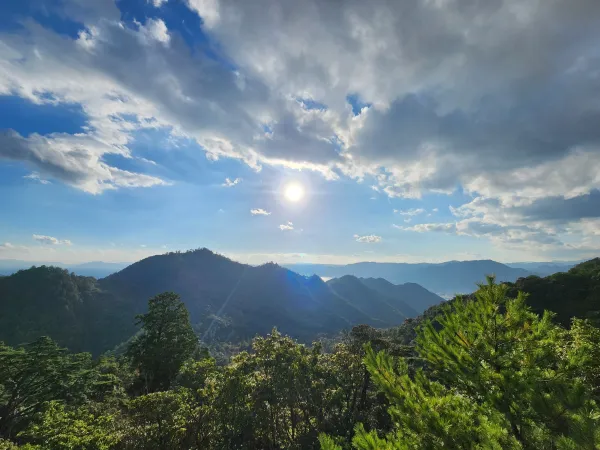
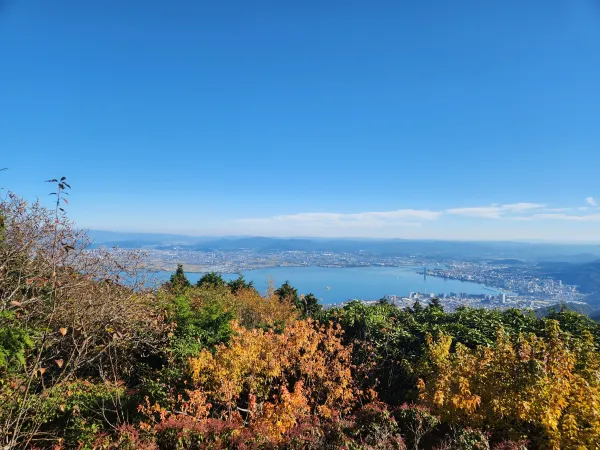
The spirit of hiking stayed with me for the remainder of my trip in Japan. Mt. Misen in Miyajima island rewarded me with some wonderful views, and Mt. Hiei with the beauty of Lake Biwa and newfound friendships. When the heart is open, it is ready to take in the world and become a part of it.
Lesson 2 - Uketamo as the metaphor for life
Accepting your conditioning and understanding it is the first step in breaking free from it.
While the training is done in silence, outside the prayers, there is one word the Yamabushi allow and often: “uketamo”. Uketamo means “I humbly accept”. In shugyō, this is what you do most of the time: you humbly accept that you don’t know (and don’t need to know). You don’t know anything about the training, in fact, you don’t even know the time at all… You don’t know when you will eat, when you will be going to bed, when you will wake up to the sound of the next conch (horagai (法螺貝)) or whether your Sendatsu will decide to take the group out for a night walk. You accept the things you are given and the things you are told to do. As Ron said, I’ll just “uketamo” that.
I interpret this as a wider metaphor for life. Just like life, you don’t know what will happen next, you don’t know when the journey starts or ends. There is a great unknown that is bigger than you. Not knowing is the beginning of acceptance and learning. It is through acceptance of our conditioning that we can begin to understand the world and ourselves. And once we understand the entire structure of it all, of ourselves, we can start to let go of “suffering”/“fear”/“monkey brain”. I think true freedom lies in the experience of going beyond all labels and cultivating this indefinitely.
Lastly, living a more ascetic life, without all the comforts of the modern world, and only the unknown as a guide, makes you appreciate things a lot more. A simple bowl of rice and a miso soup feel like a luxury. Oh, and so do the pickles, especially the very last one that you use to clean your bowls. Having soaked a bit of all the flavours, the flavour-infused pickle concludes the simple meal.
Lesson 3 - The present is always there
You have all the components within yourself to tap into the present
For the entire training, it seemed fitting to spend time at Haguro-san, in the present. Ideally, this is where I’d like to find myself most times, in the now.
Whether you believe in prayer or the Shinto Kamis, the core of the matter is this idea of reconnecting with nature, of bringing us back to our original state, one of being present and in flow with the world, where nature and its understanding were essential for survival. I am not advocating we go back to living like early hominids, after all, technology is amazing. I am just saying that here is something deeper that can be found when we close the gap between ourselves and nature. In the hikes, I felt closer to what is, the unfiltered, raw reality that is beneath the surface of all the labels. While there has been a major evolution in the technological and outer world of man, inwardly, in the psyche, we are still closer to our so-called “animalistic” ancestors than we are to a new form of enlightened being…
Nonetheless, we can awaken in our own way. The door to being present is always there, inside all of us; in fact, it comes baked in with our brains. This state of presence is akin to a state of flow where time’s passing ceases to matter, and there is only one thing in front of us.
A poem to summarise it all
We’re all somewhere along the “pathless path”, and we’re all trying to address our existential suffering.
This was an experience that I will not forget. I came into this journey with little to no expectations or knowledge about this part of the world. Like with most of life, no amount of reading, intellectualizing or memorization can prepare you for the actual feeling of doing the thing.
I recommend it to anyone who needs a reset in their lives.
The famous poem by Antonio Machado is a good summary of all this, here’s my favourite excerpt in Spanish (original) with the English translation below:
Caminante, son tus huellas el camino y nada más; caminante, no hay camino, se hace camino al andar.
Al andar se hace camino y al volver la vista atrás se ve la senda que nunca se ha de volver a pisar.
Wanderer, it is your footprints winding down, and nothing more; wanderer, no roads lie waiting, roads you make as you explore.
Step by step your road is charted, and behind your turning head lies the path that you have trodden, Not again for you to tread